No knead bread
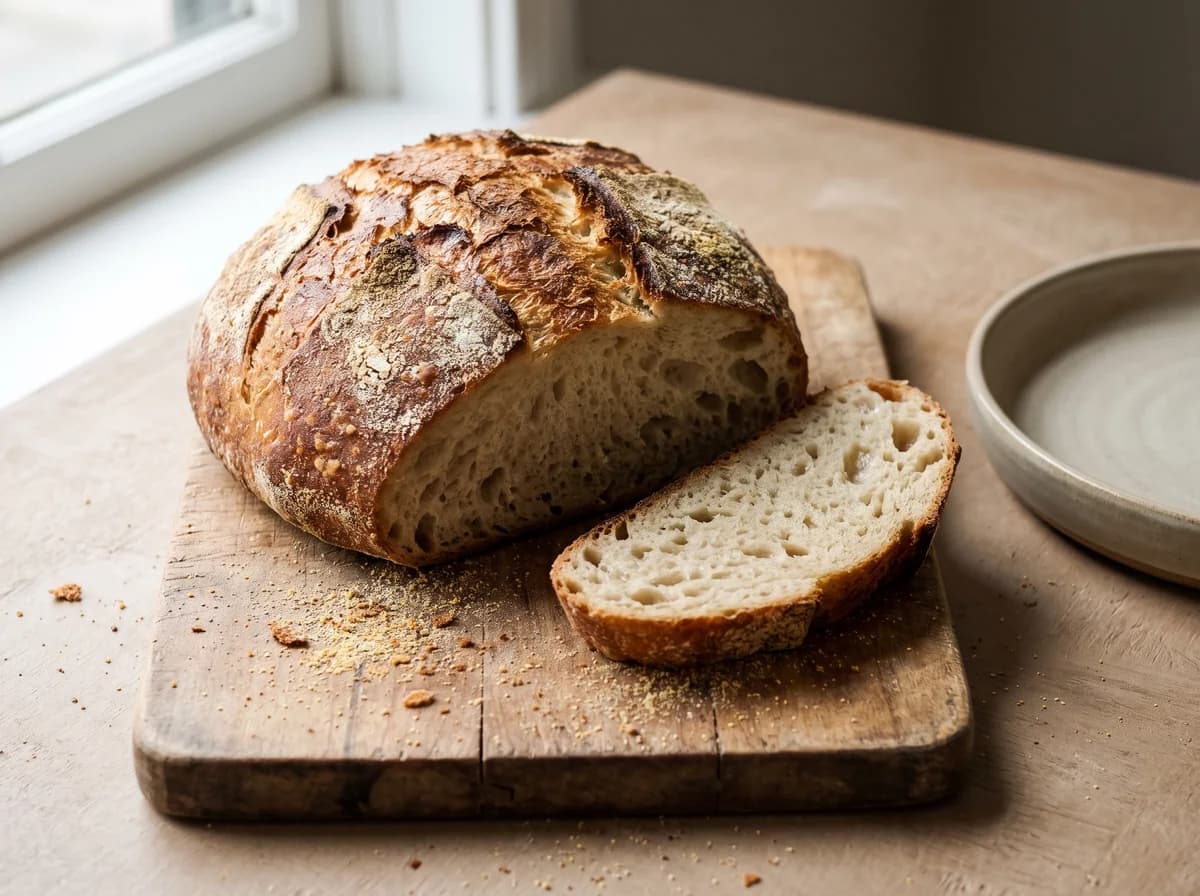
This no-knead bread yields one round boule, about 8 slices, with a crackly deep-golden crust and a chewy, airy crumb. The dough mixes with a spoon, ferments overnight, then bakes in a preheated Dutch oven for strong oven spring and even browning. It is simple to handle, but the long rest gives it real bread flavor and texture.
Estimated calories and US ingredient costs.
This recipe is best baked as one loaf in a 5 to 6 quart Dutch oven. For a larger batch, mix separate doughs and bake each loaf in its own preheated pot rather than trying to crowd one pan. Keep the oven temperature the same and do not shorten the covered bake when scaling.
Your whole cook, in one place.
Ingredients, steps and a live timeline. Ready for 8 people.
Step timeline
Cooking order
15 leftMix the shaggy dough
~1 minMix the shaggy dough.
In a large bowl, whisk together 3 cups bread flour, 1/4 tsp instant yeast, and 1 1/2 tsp fine salt.
Pour in 1 1/2 cups warm water and stir with a wooden spoon until a sticky, ragged dough forms and no dry flour remains, about 1 minute.
Cover the bowl tightly with plastic wrap or a lid.
Ingredients
- 3 cups total for recipeBread flour (13 1/2 oz/385 g)
- 1/4 tspInstant yeast
- 1 1/2 tspFine salt
Let the dough ferment
~1080 min cookLet the dough ferment.
Leave the bowl at room temperature for 12 to 18 hours until the dough has doubled, the surface is bubbly, and the mass looks loose and elastic rather than tight.
A longer rise gives a better flavor; in a warm kitchen, start checking closer to 12 hours.
Check the dish
After ~1080 minCheck No knead bread and continue when ready.
Heat the oven and prepare the pot
~45 min cookHeat the oven and prepare the pot.
During the last 45 minutes of the rise, set a 5 to 6 quart Dutch oven with its lid on the middle rack and heat the oven to 450 F.
Line a sheet of parchment paper with 1 tbsp cornmeal and keep it nearby.
The pot must be fully preheated so the bread springs upward instead of spreading sideways.
Check the dish
After ~45 minCheck No knead bread and continue when ready.
Shape the loaf gently
~1 minShape the loaf gently.
Scrape the dough onto the parchment.
With damp hands, fold the outer edges toward the center a few times, then tuck and rotate it into a rough round.
Do not knead or press out the gas.
If the dough sticks, wet your hands again instead of adding more flour, which can tighten the crumb.
Ingredients
- 3 cups total for recipeBread flour (13 1/2 oz/385 g)
Proof the shaped loaf
~45 min cookProof the shaped loaf.
Lift the parchment with the loaf and lower it into the hot Dutch oven.
Cover and let the dough rest 30 to 45 minutes while the oven stays hot.
The round should puff slightly and hold a softer dome by the end of the proof; if it spreads flat immediately, give it the full 45 minutes.
Check the dish
After ~45 minCheck No knead bread and continue when ready.
Bake covered
~30 min cookBake covered.
Bake with the lid on for 30 minutes.
The enclosed steam helps the loaf expand quickly and sets the crust before it hardens, which is what creates the tall, blistered exterior.
Check the dish
After ~30 minCheck No knead bread and continue when ready.
Bake uncovered and finish
~18 min cookBake uncovered and finish.
Remove the lid and bake 12 to 18 minutes more until the crust is deep brown and the loaf sounds hollow when tapped.
For the most reliable doneness, the center should read about 205 F to 210 F on an instant-read thermometer.
If the top darkens too quickly, tent it loosely with foil for the last few minutes.
Check the dish
After ~18 minCheck No knead bread and continue when ready.
Cool and slice
~60 min cookCool and slice.
Transfer the loaf to a rack and cool for at least 1 hour before slicing so the crumb finishes setting and the steam does not make the interior gummy
Slice with a serrated knife
After ~60 minSlice with a serrated knife
Serve meal
~1 minOnce all dishes are cooked and ready, plate and serve the meal together.
No knead bread: serve the bread warm or at room temperature for the cleanest cuts and best crust.
Make the next one yours.
Create a custom meal with what you have.
Read the traditional recipe
Ingredients
For 8 people
- 3 cups bread flour (13 1/2 oz/385 g)
- 1 1/2 cups warm water (12 oz/355 g), about 100 F to 110 F
- 1/4 tsp instant yeast
- 1 1/2 tsp fine salt
- 1 tbsp cornmeal (0.3 oz/8 g), for dusting
Method
- Mix the shaggy doughIn a large bowl, whisk together 3 cups bread flour, 1/4 tsp instant yeast, and 1 1/2 tsp fine salt. Pour in 1 1/2 cups warm water and stir with a wooden spoon until a sticky, ragged dough forms and no dry flour remains, about 1 minute. Cover the bowl tightly with plastic wrap or a lid.
- Let the dough fermentLeave the bowl at room temperature for 12 to 18 hours until the dough has doubled, the surface is bubbly, and the mass looks loose and elastic rather than tight. A longer rise gives a better flavor; in a warm kitchen, start checking closer to 12 hours.
- Heat the oven and prepare the potDuring the last 45 minutes of the rise, set a 5 to 6 quart Dutch oven with its lid on the middle rack and heat the oven to 450 F. Line a sheet of parchment paper with 1 tbsp cornmeal and keep it nearby. The pot must be fully preheated so the bread springs upward instead of spreading sideways.
- Shape the loaf gentlyScrape the dough onto the parchment. With damp hands, fold the outer edges toward the center a few times, then tuck and rotate it into a rough round. Do not knead or press out the gas. If the dough sticks, wet your hands again instead of adding more flour, which can tighten the crumb.
- Proof the shaped loafLift the parchment with the loaf and lower it into the hot Dutch oven. Cover and let the dough rest 30 to 45 minutes while the oven stays hot. The round should puff slightly and hold a softer dome by the end of the proof; if it spreads flat immediately, give it the full 45 minutes.
- Bake coveredBake with the lid on for 30 minutes. The enclosed steam helps the loaf expand quickly and sets the crust before it hardens, which is what creates the tall, blistered exterior.
- Bake uncovered and finishRemove the lid and bake 12 to 18 minutes more until the crust is deep brown and the loaf sounds hollow when tapped. For the most reliable doneness, the center should read about 205 F to 210 F on an instant-read thermometer. If the top darkens too quickly, tent it loosely with foil for the last few minutes.
- Cool and sliceTransfer the loaf to a rack and cool for at least 1 hour before slicing so the crumb finishes setting and the steam does not make the interior gummy. Slice with a serrated knife and serve the bread warm or at room temperature for the cleanest cuts and best crust.
Before you cook
What to get ready
Mixing bowl, dough scraper, the specified loaf pan, griddle or covered baking pot, and cooling rack.
Plan around the long fermentation and use oven-safe equipment rated for the specified baking temperature.
If something needs adjusting
Loaf is gummy when sliced
Let it cool fully on a rack; a hot crumb has not finished setting.
Dough rises slower than expected
Judge expansion and feel rather than the clock alone. A cool room slows fermentation; very hot liquid can damage yeast.
Store for later
Cool completely before wrapping. Keep plain bread covered for short-term use and freeze sliced portions for longer storage; discard moldy bread rather than trimming the spot.
Make the ingredients go further
Freeze sliced leftovers for toast rather than keeping the whole loaf until stale.
Next use for your ingredients: Grilled cheese sandwich →
Calculate this meal with your own prices →
How to Tell When Dough Has Risen →
Cooking notes updated October 24, 2026. How we create recipes.
Tips, swaps and questions
A little kitchen know-how
For a lighter crumb, let the dough rise until it is fully bubbly and jiggly rather than rushing to the next step. Handle it with wet hands instead of extra flour, and make sure the Dutch oven is fully preheated. That hot, covered start is what gives this bread its tall shape and crisp crust.
Make it work for you
For a nuttier loaf, replace up to 1 cup of the bread flour with whole wheat flour and add 2 tbsp more water. Whole wheat absorbs more moisture, so the dough will feel firmer and the crumb will be a little tighter. Keep the covered bake the same and lean toward the longer uncovered finish.
Use more of your bread flour and instant yeast in anchovy olive pizza.
Why does my no-knead bread turn out dense?
Dense bread usually means the dough was too dry, underfermented, or baked in a pot that was not fully hot. The dough should be sticky and bubbly after the long rise, and the loaf should get a full preheat in the Dutch oven. Let it cool at least 1 hour before slicing so the crumb can set.
Times are estimates. Check ingredients for allergens. For safe temperatures and storage, see FoodSafety.gov.